Check three different home-value trackers for Portsmouth this month and you'll get three different stories. One shows the median sale price down close to 20 percent from a year ago. Another shows average home values still climbing, just more slowly than they were in 2025. A third shows the median list price barely moved at all. If you're comparing a home you own, or one you're about to make an offer on, against "the Portsmouth market," you've probably noticed the numbers don't agree with each other, and they don't agree with what your own street looks like either.
They're not wrong. They're measuring different things pulled from the same pool of sales, and that pool just started including a very different kind of transaction than it used to.
What One January Actually Sold For
Look at what actually closed in Portsmouth over about two weeks in January 2026, and the disagreement between trackers starts to make sense.
| What Sold | Closed | Size | Price |
|---|---|---|---|
| Studio condo, Deer Street | Jan 9, 2026 | 459 sq ft | $399,900 |
| Single-family, Pleasant Street | Jan 15, 2026 | 1,443 sq ft | $1,325,000 |
| Condo, Shearwater Drive | Jan 16, 2026 | 2,489 sq ft | $1,435,000 |
| Single-family, Hanover Street | Jan 20, 2026 | — | $1,225,000 |
| Single-family, Marcy Street | Jan 21, 2026 | 1,716 sq ft | $1,075,000 |
Five sales, one city, one month, and a spread from under $400,000 to over $1.4 million. A citywide median takes all of that and reduces it to a single line. That line tells you almost nothing about whether any individual home gained or lost value. It tells you what happened to be in the sample that month. Change what's in the sample, and the median moves, even if every home on Marcy Street and Hanover Street is worth exactly what it was worth before.
That's the mechanism behind the number that's confusing everyone right now. And it's about to matter more, not less, because of a law that took effect this summer.
The Law That's About to Make the Spread Wider
On July 1, 2026, New Hampshire's House Bill 631 took effect statewide. The law, signed by Governor Ayotte and codified as Chapter 201 of the 2025 session laws, requires municipalities to allow multifamily residential development on commercially zoned land as a matter of right, provided the site has adequate roads, water, and sewer capacity or the developer provides it. Before HB 631, converting a commercial parcel into housing generally meant applying for a variance under a strict state standard, followed by a public hearing where a zoning board could weigh in on traffic, parking, and neighborhood character. HB 631 removes that variance step for qualifying projects. Site plan approval still applies.
The legislature also passed two companion measures addressing other aspects of the process. According to Hinckley Allen, HB 1010 lets towns require infrastructure studies before approving a project, but only for capacity questions. According to Governing, HB 1588 goes further: it bans density caps on qualifying projects, limits parking mandates to one space per unit, and lets developers recover attorney's fees if a municipality wrongly blocks a project and loses at the state Housing Appeals Board or in court. Together, the three laws tell developers something concrete: the by-right pathway isn't a loophole that will get closed next session. A 2025 statewide poll found 88 percent of registered voters support allowing housing in commercial zones, which is part of why lawmakers reinforced HB 631 this year instead of rolling it back.
For a city like Portsmouth, where commercially zoned land sits close to the water, close to Interstate 95, and close to downtown, that combination of legal certainty and geography is exactly what gets projects moving.
Where the New Supply Is Actually Landing
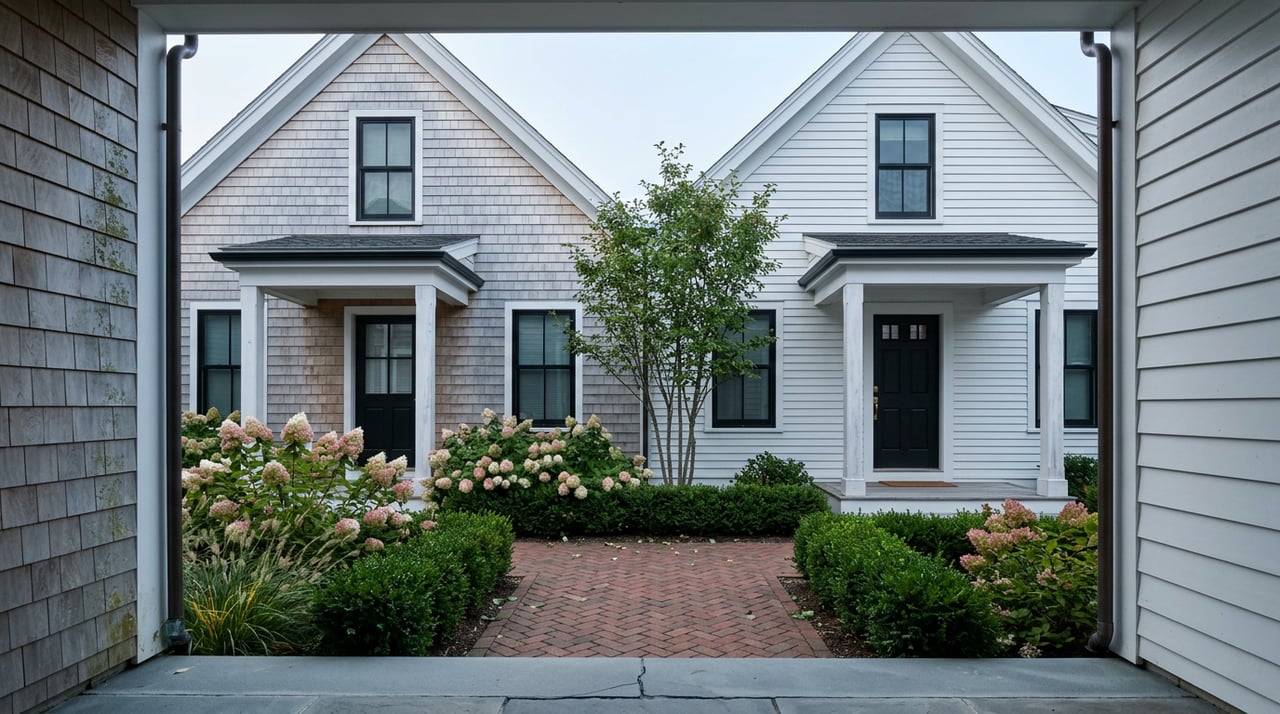
The West End and North End are where this plays out on the ground. Woodbury Reserve, a pocket community built to blend with the surrounding streetscape, has been selling twin townhome units running roughly 2,282 square feet. Eden Point, just a mile and a half from downtown, is a small run of six single-family condominium homes near 1,990 square feet each, built with an HOA that handles exterior landscaping and snow removal. On the higher end, The Grove at West End, developed by Copley Properties, lists new construction starting near $1.6 million, a reminder that not every new project pulls the average down.
The North End tells a different part of the story. A 21-unit condominium building at 238 Deer Street has been marketed with studio and one-bedroom floor plans, the kind of compact urban product that didn't have an easy path onto commercial land under the old zoning rules. That's the building where the $399,900 studio sale in January came from. Sage Portsmouth, a newer condo community offering concierge services and a fitness center, recently repriced units for what its listing called a "fall release," a sign that builders are actively testing price points on smaller units rather than holding firm.
None of these projects broke ground because of HB 631 itself. Most were already underway before the law took effect. What HB 631 does is remove the next layer of friction for the projects that come after them, on parcels that previously would have needed a variance to add housing at all. The city also spent the first half of 2026 replacing sewer, water, and stormwater infrastructure along Congress Street, work that ran from January through early June. Chinburg has been the most active new-construction developer working in the city, and the incentive structure now favors exactly this kind of smaller-footprint, higher-density product on land that used to be zoned strictly for retail or office use.
Why Downtown Doesn't Move the Same Way
Portsmouth's colonial-era core doesn't get the same treatment, and that's by design. Properties inside the city's historic district still need approval from the Historic District Commission before exterior alterations, new construction, or in some cases even repainting. That review layer exists to preserve architectural character, and it applies regardless of what HB 631 does for commercially zoned parcels elsewhere in the city. The state law targets commercial zoning specifically. It has nothing to say about a residential lot on a street lined with pre-1900 structures near Market Square.
That's why the growth is landing on the edges rather than the center. Single-family homes near downtown, the kind that sold on Marcy Street, Hanover Street, and Pleasant Street for well over a million dollars in January, sit in a different regulatory lane entirely from the studios and townhomes going up in the West End and North End. Both categories show up in the same monthly citywide statistic. Only one of them is expanding in volume right now.
Reading the Number Correctly From Here
If you're watching Portsmouth prices because you're planning to buy or sell in the next year, the headline median is going to keep doing strange things as more small-footprint, by-right product closes alongside the existing single-family stock. A few things worth keeping in mind:
- A citywide median blends property types that don't compete with each other. A studio condo and a four-bedroom colonial near Market Square are not comparable inventory, even though both count equally toward the same monthly figure.
- Expect more volatility in the median specifically, not necessarily in the value of any particular home, as HB 631 projects complete through the rest of 2026 and into 2027.
- If you're pricing a listing or evaluating an offer, the relevant comparison is recent sales of similar property type and location, not the citywide number reported by any single tracker.
- New construction pricing in the West End and North End reflects the economics of that specific product type, land cost, and construction cost per unit, which is a separate question from what an established single-family home nearby is worth.
A Couple of Questions Worth Settling
Does HB 631 affect my house if I'm in a single-family residential zone? No. The law applies only to land zoned commercial, office, retail, or parking, where multifamily housing wasn't previously allowed. A residential zone isn't touched by this statute directly.
Will the median keep swinging around like this? Likely, at least for the next several sales cycles, as more compact units financed under the new by-right pathway close and enter the data alongside existing single-family sales.
Should I wait for the numbers to settle before selling? A citywide median was never a precise measure of what any single home is worth. Comparable sales in your specific micro-market tell you more than a blended figure does, whichever direction that figure happens to be moving this month.
If you're trying to make sense of what a listing or an offer actually means in this market, that's the kind of read worth getting right before you act on it. Carol Seniuta works across Portsmouth and the Seacoast every week and can walk you through what's really driving the number on your street. Let's Connect.
This article is general information, not legal, tax or financial advice. Consult a qualified professional about your situation.